July Brings New Wildflowers #1, White

Recording changes in wildflower and plant populations as the seasons progress…

Bouncing Bet (Saponaria officinalis).

This is a non-native plant with several alternate names (Soapwort, Latherwort, Lady’s-wash Bowl, London Pride). Since early July it has become very prevalent along local gravel roads; unsurprisingly it is described as quite invasive. Locally the flower is white with a hint of lavender. The lavender is more pronounced in some images online.

Many of this plant’s names refer to the fact that it has commonly been used in the past to make soap. Its name “London Pride” reflects that it was planted alongside city streets to mask smells of poor sanitation.

Its “main” name, Bouncing Bet, has a fairly ridiculous origin. Reportedly, it is because the flower’s petal resembles the rear view of a bent-over washerwoman (name of Bet).

Campion, a wildflower that blooms a few weeks earlier, looks somewhat similar.
Yarrow (Achillea millefolium).

This is a plant native to the temperate regions of the northern hemisphere that is renowned for medicinal properties. Its genus name (Achillea) was assigned by Linnaeus in 1753 and refers to the Greek hero Achilles, who supposedly used yarrow to staunch his warrior’s wounds. A fellow blogger has checked on this and finds that the herb used by Achilles really never was explicitly identified as yarrow.

In any case, yarrow has been used for centuries as a treatment effective in stopping the flow of blood from wounds. Warriors in the days of sword fighting particularly relied on it. Native Americans used yarrow extensively for pain relief. Remarkably, yarrow residue has been detected in tartar from 50,000 year-old Neanderthal teeth. Because yarrow is bitter, the assumption is that this Neanderthal was using it as medicine and not food.

In the Middle Ages, before the use of hops in brewing, yarrow was one of many bitter herbs used to flavor beer. The mixture of these herbs was called gruit.

The species name of yarrow, millefolium, means “thousand leaves”, appropriate because of its many finely divided leaflets. The horribly invasive Eurasian watermilfoil is a different plant (Myriophyllum spicatum).

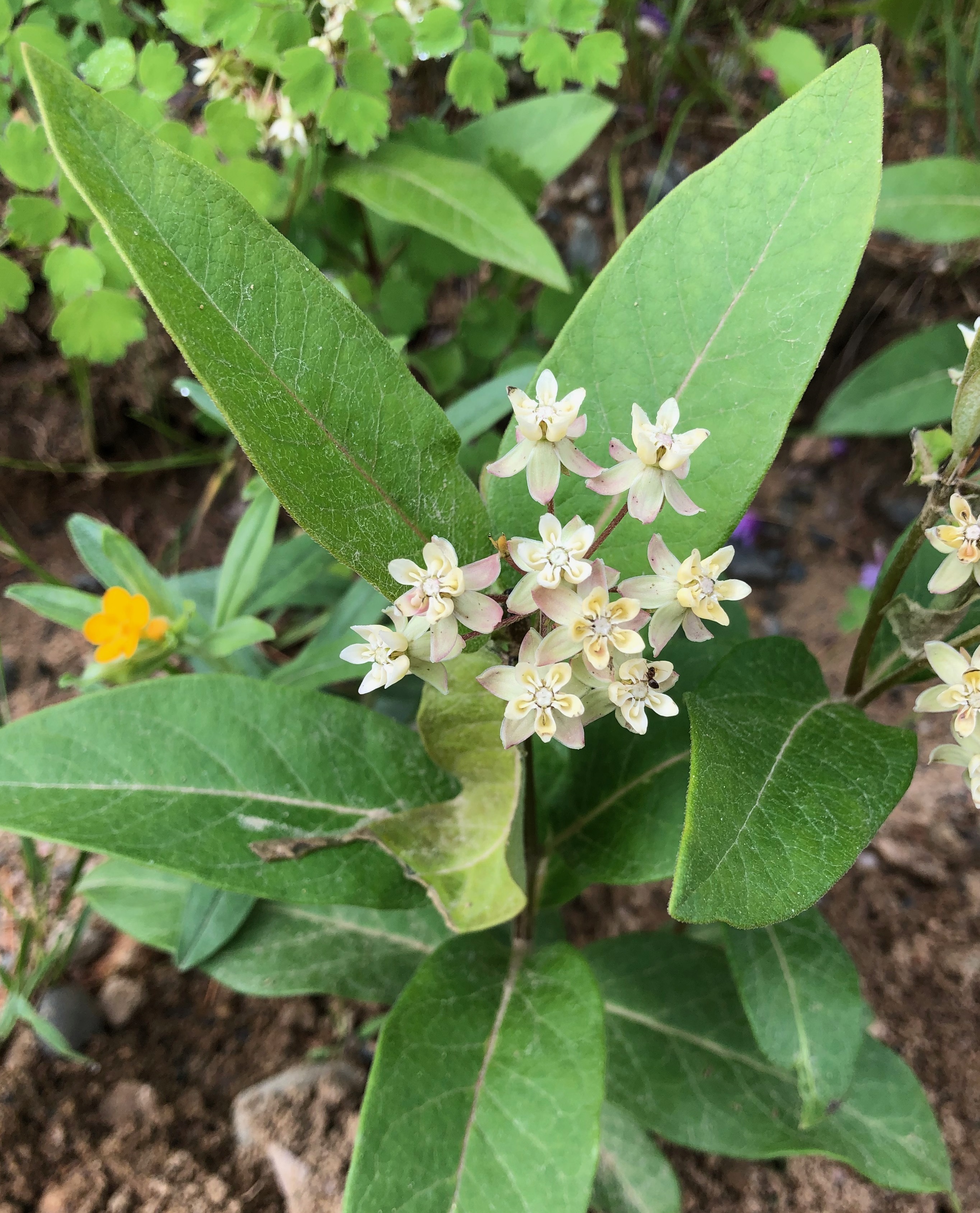
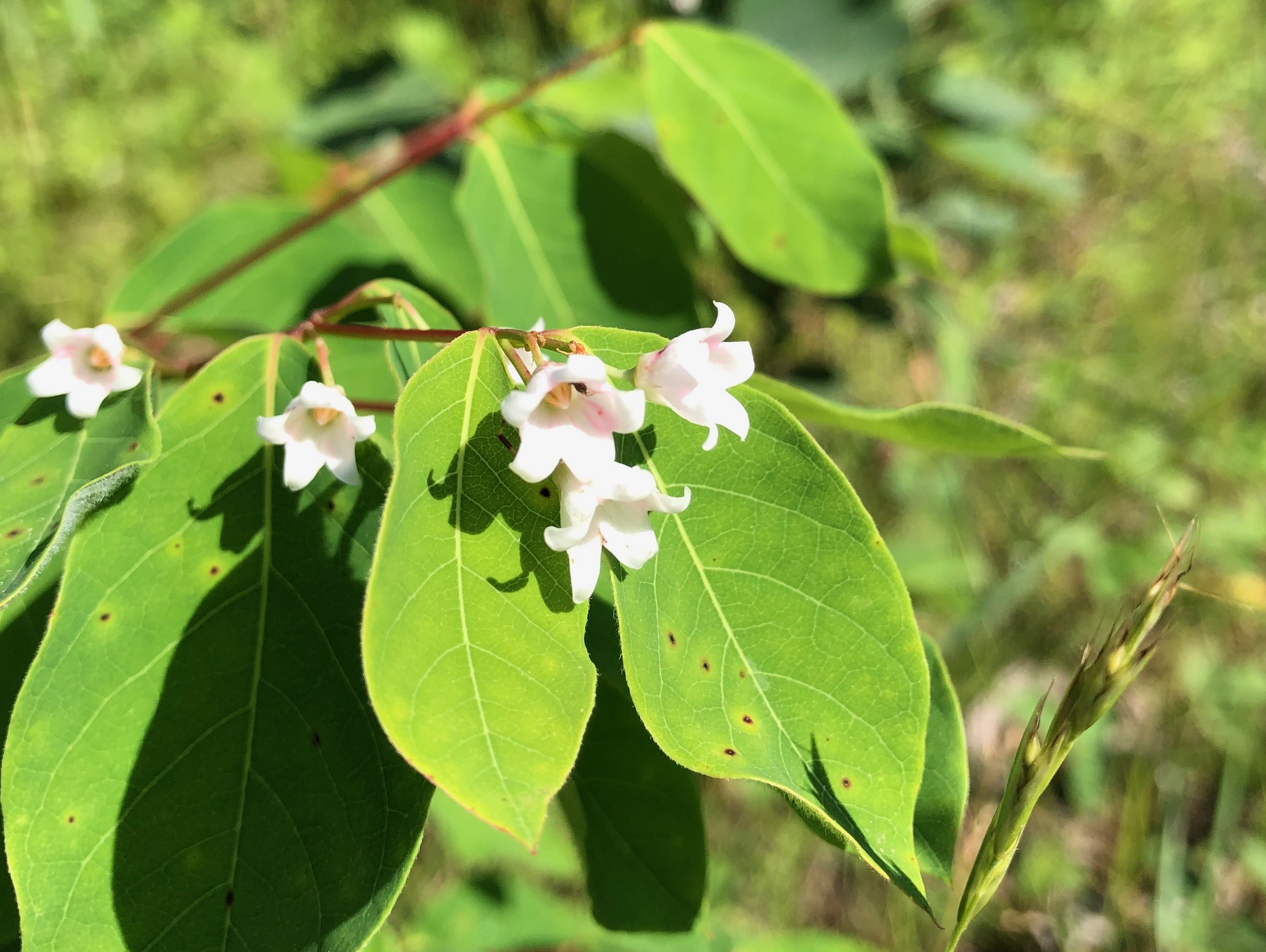
Spreading Dogbane (Apocynum androsaemifolium)

Spreading dogbane is small bushy plant with fairly inconspicuous white flowers, it becomes more noticeable in the fall when its leaves turn bright yellow. Plants in the dogbane and milkweed family are related. Like milkweed, this plant bleeds a sticky white sap that is somewhat toxic to people (and dogs).

Also like milkweeds, the nectar of dogbane flowers are an important food source for monarch butterflies. Butterflies, with their long tongues, can safely access the nectar of these flowers. Flies, with short tongues, are commonly trapped by the flower; which explains its alternate name, Fly-trap Dogbane.

White Sweet Clover (Melilotus alba)

The “Picture This” app identifies this by an alternate name, Honey Clover. This clover is an invasive species from Eurasia; it was brought to North America long ago as a forage crop. Now many states consider it a noxious weed.

The problem with White Sweet Clover is that it can out-compete native species. If unchecked it can displace desirable natives in grasslands.

The plant has many seemingly desirable characteristics. Like most legumes, its roots are associated with nitrogen-fixing bacteria that fertilize soil. It has also been planted because it is a good source of nectar for honey bees.

There is a good online report from the US Department of Agriculture that reviews several applications where White Sweet Clover was once considered beneficial. It goes on to discuss undesirable effects of its introduction that were not initially apparent. A non-expert (like me) gets the impression that the presence of sweet clover has pros and cons that are complicated and thus is a subject of considerable study.

Other Roadside Features

Previous posts have focused on the plants along the roadside, but a few other interesting things deserve attention. This post features two of them.

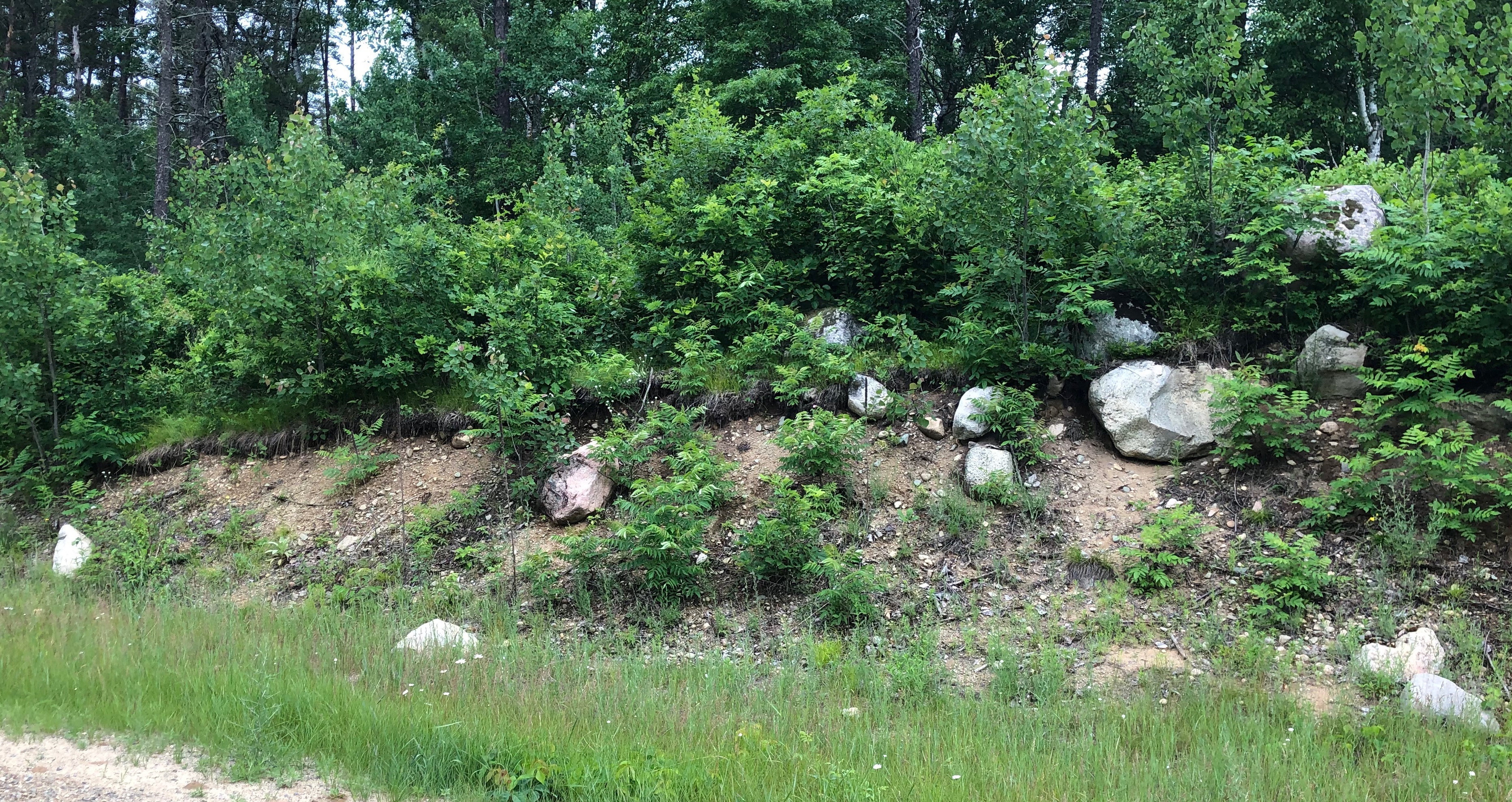
Glacial Till

Alongside our gravel road there is this terrific exposure of the glacial till that covers the entire region. Glacial till is a catch-all term for the sediment left behind as glaciers receded. This sediment is extremely poorly sorted, including everything from boulders to clay. This poor sorting is diagnostic of glacial deposits; sediments deposited by water or wind typically have more uniform particle sizes.

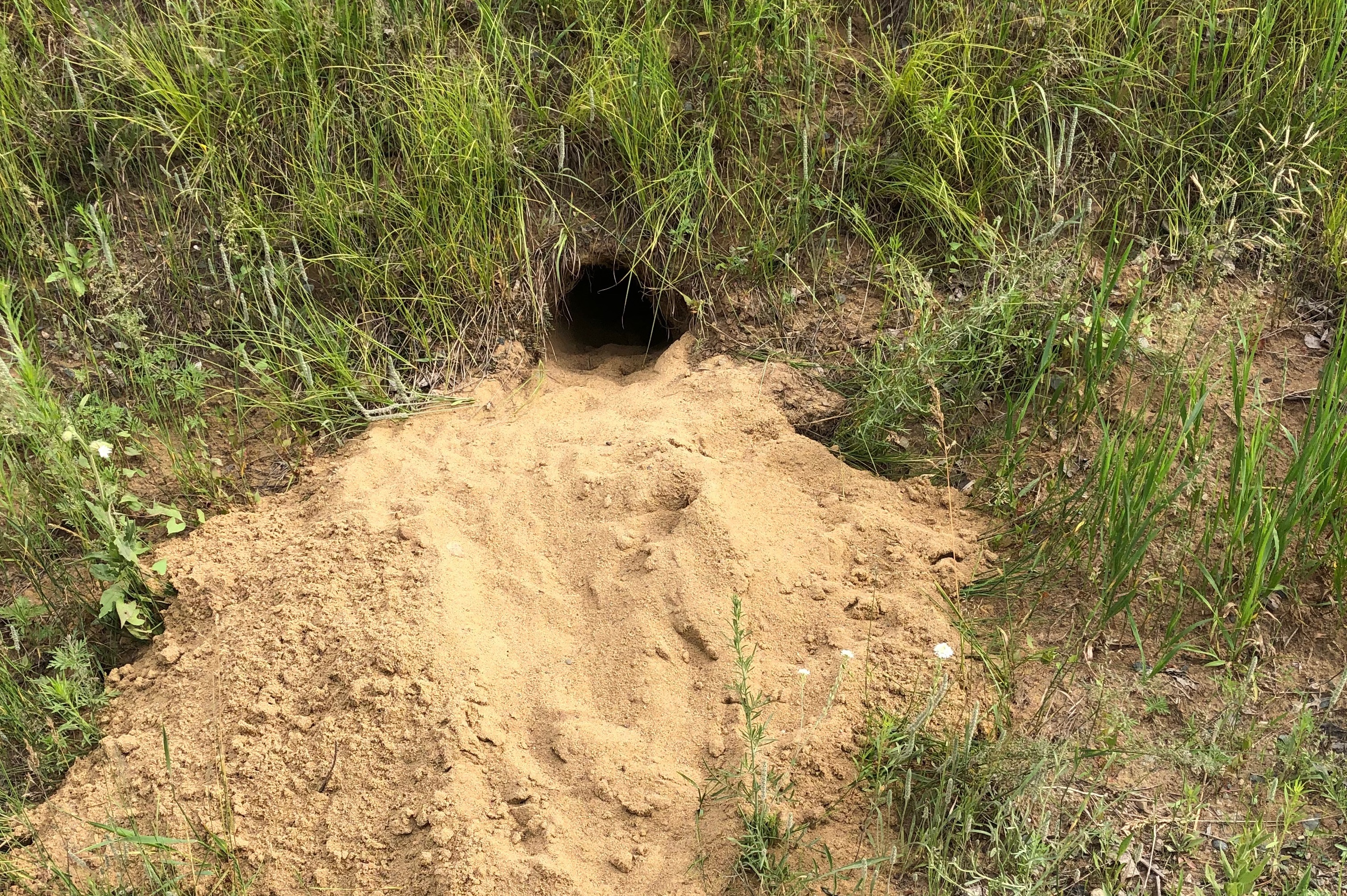
Anybody Home?

Two weeks later, not much change.

Further up the same road some animal has apparently made a home for itself. Online sites are available that provide hints on how to identify the animals responsible for holes like this. Fox and badger seem to be the most likely candidates. The hole is slightly larger than the typical fox hole (20cm), but indistinct paw prints that can be seen in the second picture more resemble examples of fox prints. Yet to be determined…

Purple

Previous posts have covered the white, yellow and pink wildflowers we have seen in June along the roadside in Northern Minnesota. Purple is another common color for the local wildflowers, and today we’ll focus on those.

Prairie Phlox (Phlox pilosa)

Along our roadside Prairie Phlox is concentrated in a sandier area that gets lots of sun. This photo was taken on June 20, about at the height of its display. It has a wide distribution, found from Florida to North Dakota.

Prairie Phlox is also a popular garden plant, available from several nurseries, especially those specializing in native plants. It is very attractive to butterflies, which are required by the plant for cross-pollination.

Harebell (Campanula rotundifolia)

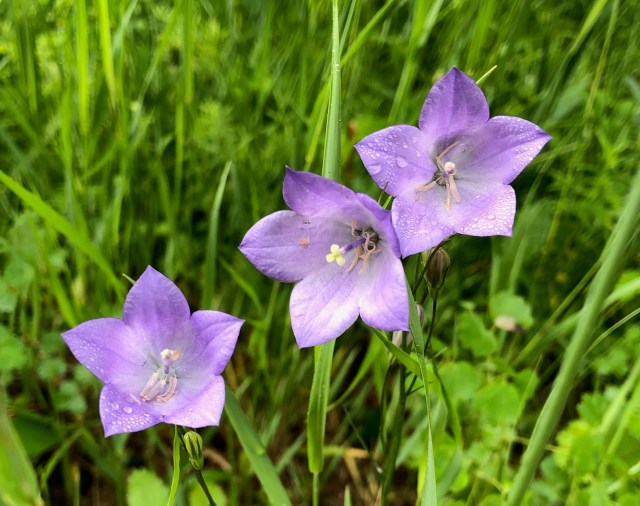
Harebell has a number of alternate names, The “Picture This” app calls it Bluebell Bellflower. We first notice Harebell blooming in mid-June and it has continued since then. The plant appears delicate, but actually is very hardy. It blooms throughout the summer and is able to flourish in rocky soils.

Harebell is found throughout the Northern Hemisphere, but is most commonly associated with Scotland. It was once used there to make blue dye to color Scottish tartans, and it is the symbol of the MacDonald clan.

Large Beardstongue (Penstemon grandiflorus)

This plant in the snapdragon family (Scrophulariaceae) is really striking! We saw it blooming on June 25 while biking along the Heartland Trail near Nevis MN. The Large Beardstongue blooms for a short time in May-June and is relatively rare as a wildflower; it is most commonly found in the northern Great Plains states.

This is another plant that is available for home gardeners from nurseries specializing in native plants. It is very attractive to hummingbirds and bees.

Self Heal (Prunella vulgaris)

This plant is different from the wildflowers previously described. It wasn’t seen along the roadside or in the woods; I was surprised to find a patch of it in the middle of my lawn. I read that it is characterized by purple multi-flowered spikes, but I mow too frequently to have seen that.

Self Heal is a member of the mint family (Lamiaceae). Like other mint plants it tends to invasively take over wherever it is planted. Unlike other familiar mint plants, it does not have distinctive smell or taste. It does attract butterflies and bees.

As its name suggests, Self Heal has been considered to have several beneficial medicinal qualities. Reportedly in the past it was highly esteemed by herbal healers. The tannins contained in Seal Heal likely allow it to soothe sore throats, as well as other sores and wounds. Recent research has found that Self Heal is also a strong antioxidant.

As an update…

To show its appearance outside of my mowed lawn, the picture to the left shows Self Heal along the roadside.

State Flower and More

Yesterday while biking around the area, I managed to get a few interesting photos

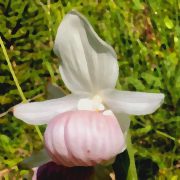
The best find was this clump of Showy Lady Slippers (Cypripedium reginae), the state flower of Minnesota. Previously I had only seen blooming Lady Slippers in late June, so I was surprised and pleased by this fine display on July 8.

Who would expect that Minnesota would be the only state with an orchid as its state flower? Prior to 1925, when the state passed laws protecting the plant, Lady Slippers were commonly seen decorating rural churches in the summertime.

Lady Slippers are uncommon and slow-growing. A plant may grow 16 years prior to blooming. However they can live 50 years or more.

You can see that this is not a good picture, but it was fun seeing these Sandhill Cranes along the road. They flapped down in front of me and ran down the road as I approached, so this photo is the best that could be done with just an iphone.

Sandhill cranes (Grus canadensis) have an interesting recent history. In the 1800’s and early 1900’s over-hunting severely reduced the number of this once-abundant species. In the 1940’s their population in Minnesota was estimated at only 40-50. Since conservation measures have been implemented, these cranes have made a remarkable comeback. Recent counts in Minnesota have found thousands of these birds.

They have rebounded to the point that some farmers consider them a nuisance, because they eat grains. Limited hunting of the cranes has been re-established in some areas. They reportedly are edible, tasting like pork chops; probably because of their grain-based diet.

To end this entry; here is a scenic shot of the lake taken right before sunrise.

Loon Update #1

Below are a few better photos of our loon family — better mainly because I was able to borrow a real camera vs. just using an iphone. Maybe I should go shopping…

The image above shows the family of three loons occupying our lake this year. Baby loons, called chicks, can swim nearly immediately after hatching, and start diving within 2-3 days. At this point the family abandons their nest and moves to a “nursery area” of the lake while the chick develops.

This chick appears to be thriving. Yesterday we saw it diving and swimming long distances underwater.

The male loon picks the nesting site for each breeding pair and vigorously defends it from loon “floaters”. Floaters are 2-7 year-old unpaired loons that drift from lake to lake — the outsiders of loon society.

The loon in the image above is showing off his territorial display — in this case to warn away me and my kayak.

The geographic distribution of loons over the year is illustrated in a beautiful map provided on the website of the Cornell Lab of Ornithology.

More updates to come…

Pink

In addition to yellow and white, pink and purple are common colors for local wildflowers. Pink and purple are somewhat similar and could be grouped in one post, but that would be too long. So, today I’ll review the pink flowers we’ve seen in June; expect a post with the more purplish flowers soon.

Smooth Wild Rose (Rosa blanda)

When seeing this flower I assumed it was the Prairie Rose (which I am familiar with as the state flower of North Dakota). However, the “Picture This” app identifies these common roadside roses as the Smooth Wild Rose. The two are similar, but the Minnesota Wildflower webpage cites the lack of prickles on new stems as the distinguishing characteristic.

Wild Geranium (Geranium maculatum)

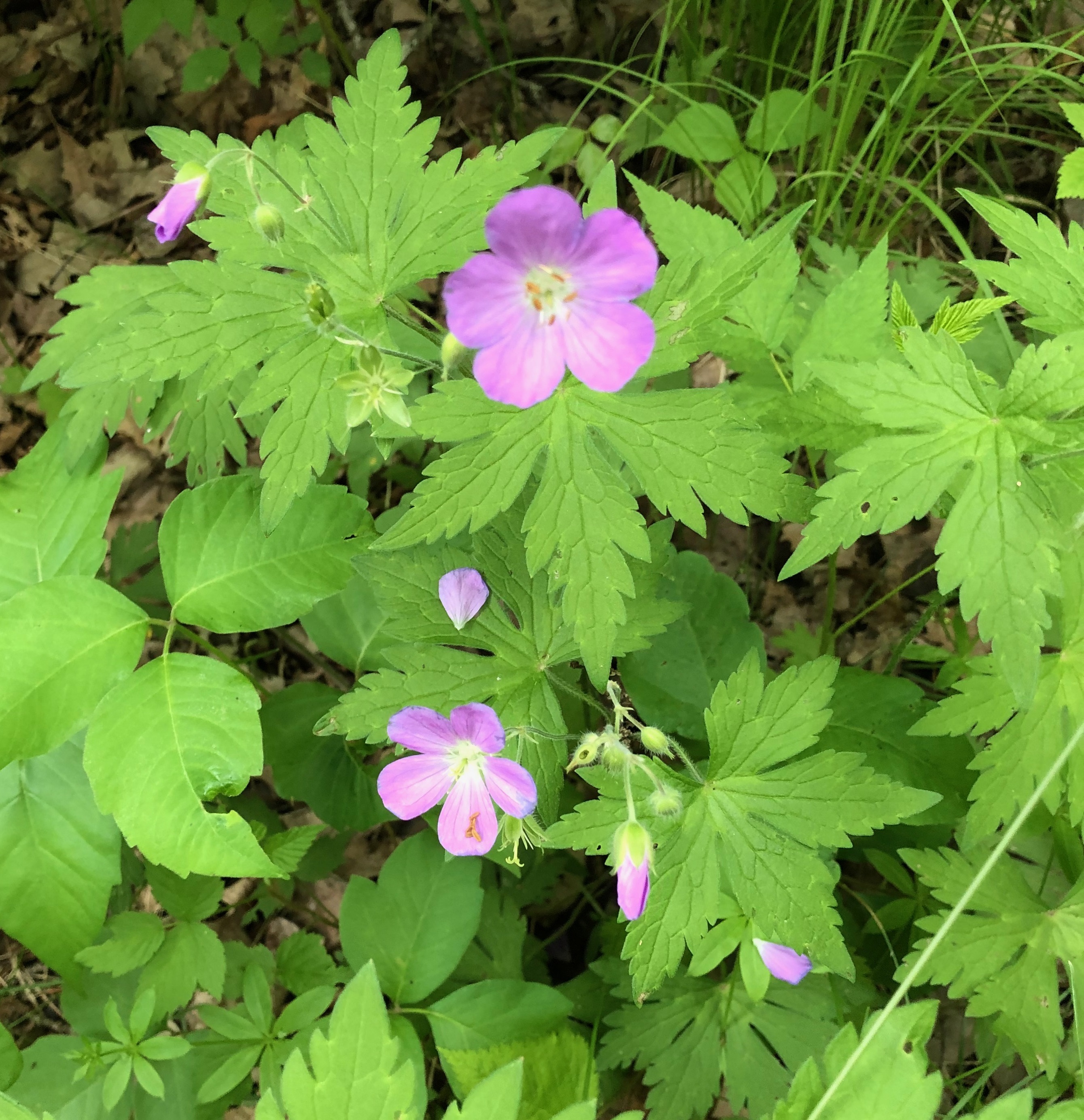
The Wild Geranium is an attractive plant found commonly in shadier areas along the roadside. It blooms for only a short time in June.

Being familiar only with the geraniums offered by nurseries, I was surprised to learn of this common native related species. This wild geranium can be cultivated for use as an ornamental plant.

Philadelphia Fleabane (Erigeron philadelphicus)

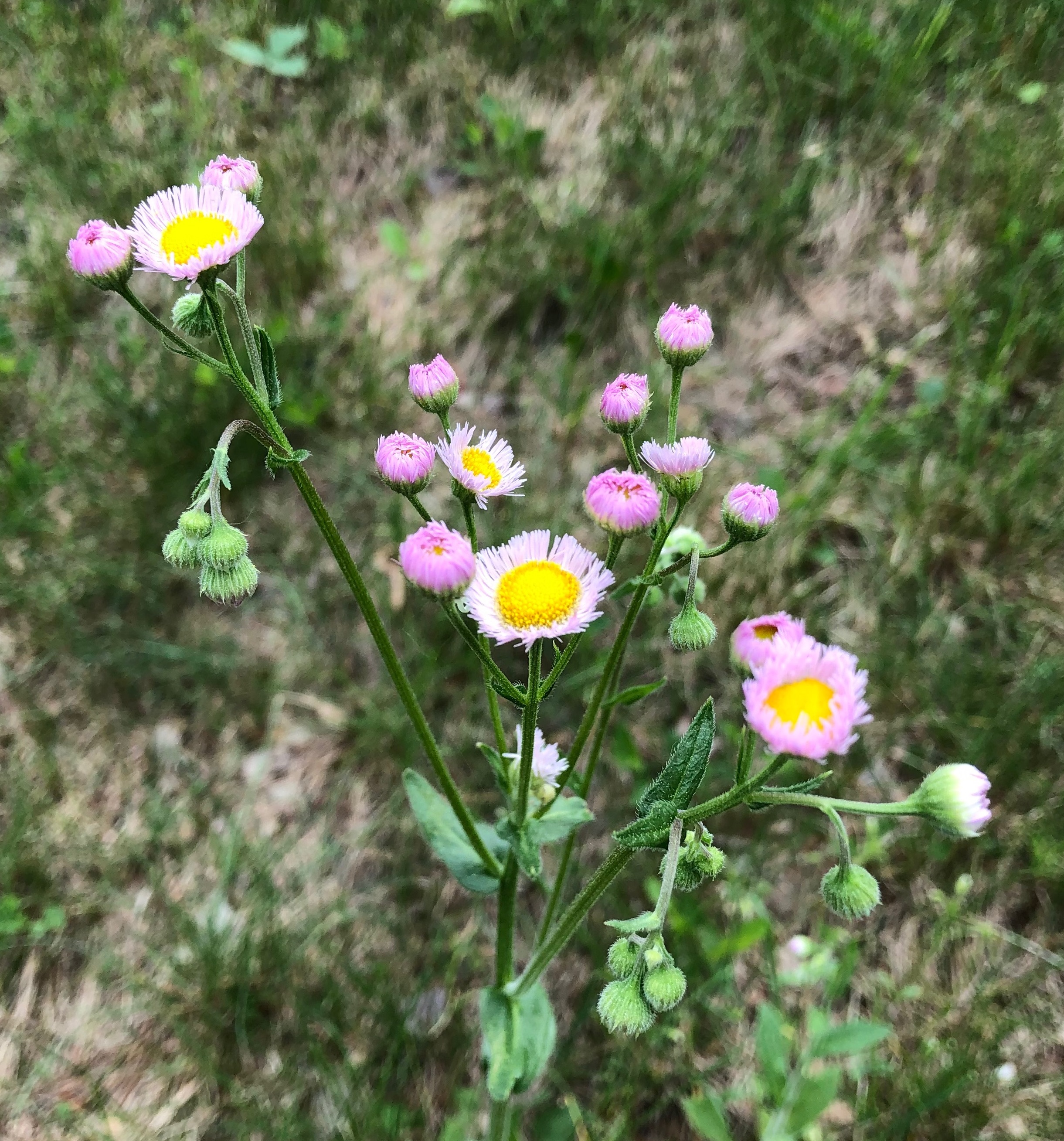
Given the name of this plant, I was expecting to learn of interesting links to Philadelphia and stories on how it may be effectively used to repel fleas. Unfortunately , there actually is no evidence that it is effective as a insect repellent, and I found no reason for it being named after Philadelphia.

It is native to North America, and is an invasive species in Europe and Asia.

Here in Minnesota it has light pink to nearly while flowers and has a gangly, weedy form. It is a common roadside plant that has been in bloom since mid-June.

An Odd Thing about Sunsets

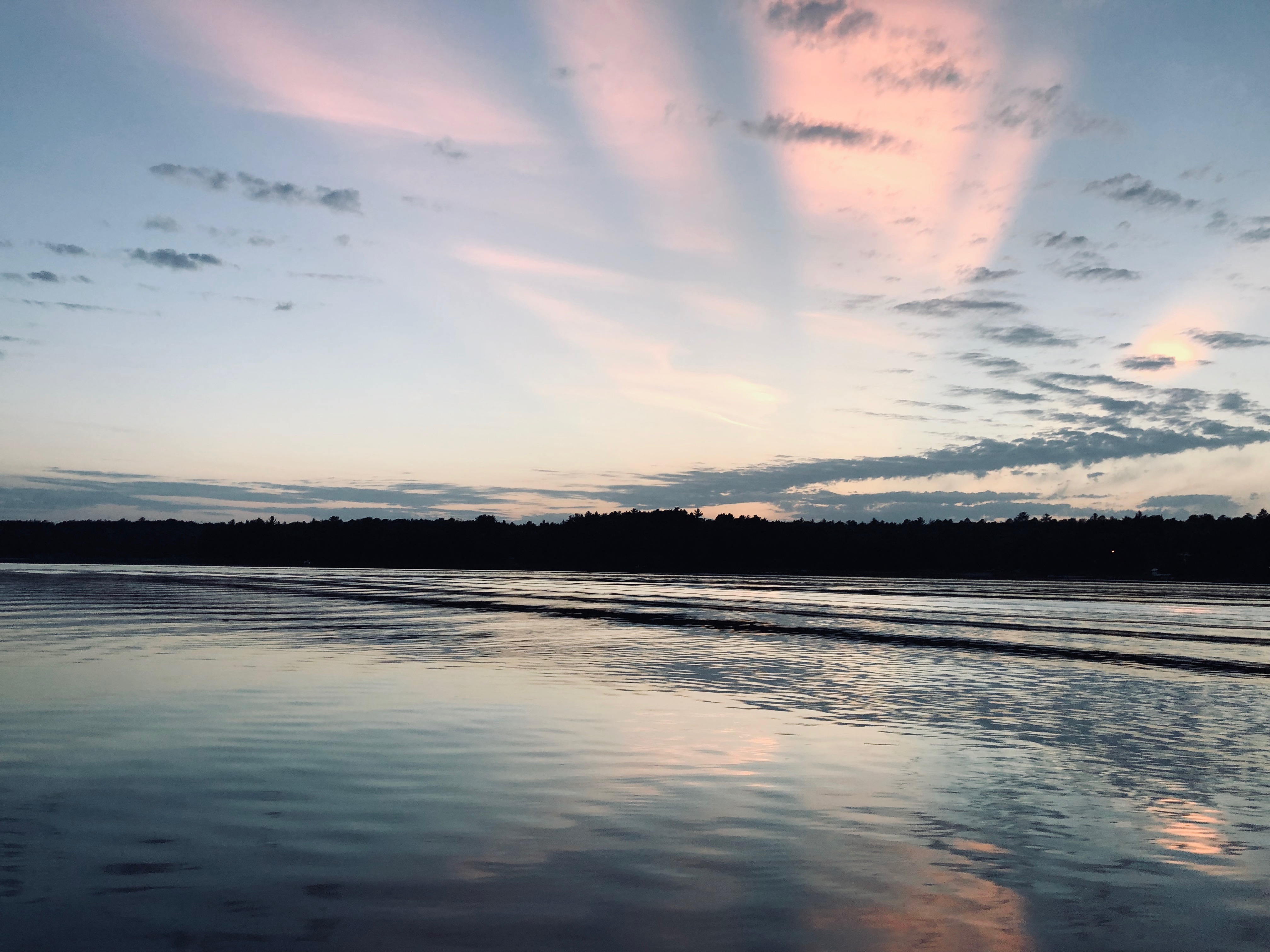
Often we walk down to the lake around 9:30 to look at the sunset. At first we see something like the image below, very nice but not breathtaking.

Thinking it is over, we climb back up to the house. Then, looking over our shoulders…we are compelled to run back down to see the encore. Maybe an analogy about aging and retirement could be made….

Happy 4th!

Evenings on the Lake with Loons

The last two days we’ve enjoyed being on the lake in the evenings

The lake was still and slight cloud cover made for dramatic skies

In this image one of the lake’s islands is in the foreground

A family of loons has made the lake their home this summer

Two adult loons are commonly seen (and heard) in the evenings accompanied by a baby. We didn’t get a good picture of the group, but managed to capture a shot of one of the loons singly. I hope to share updates about these loons throughout the summer.

The loon is the state bird of Minnesota, more loons live here than in any other state (except Alaska). According to the Minnesota DNR, in summer we have about 12,000 loons in Minnesota. Our MLS soccer franchise, Minnesota United FC, has the loon as its mascot.

The loon may be best know for its calls that echo across our lakes throughout the season. On the website The Voice of the Loon you can hear the four distinct calls of the loon — the tremolo, wail, yodel and hoot.

Useful Knowledge

The previous posts have information that may be interesting, but is not exactly critical stuff to know. This post attempts to correct that by providing info that is at least somewhat useful.

A Highly Noxious Plant

Western Poison Ivy (Toxicodendron rydbergii)

Poison Ivy is recognized by groupings of three oval pointed leaves, its woody stems, and small green berries that persist throughout winter.

Its sap contains the toxin 3-n-pentadecyl-catechol, aka urushiol, which is found throughout the plant. This poison oozes from poison ivy when it is bruised or broken, and remains toxic indefinitely. Sensitivity to poison ivy varies among people, but very few are totally immune. Particularly insidious is inhalation of smoke from burning poison ivy, which can cause severe allergic reaction.

Our dogs sometimes walk through poison ivy along the roadside with no problems. This is not unexpected, apparently only humans are susceptible. Several animals actually eat poison ivy berries without ill effects.

Under the Minnesota Noxious Weed Law, landowners can be forced to eradicate colonies of poison ivy

Wolves in sheep’s clothing

Orange Hawkweed (Hieracium aurantiacum) and Hoary Alyssum (Berteroa incana)

These flowers are attractive, but are actually quite undesirable.

We noticed orange hawkweed (aka Fox-and-Cubs) along the Heartland bike trail near Akeley MN. Initial enthusiasm about finding something new evaporated upon learning that it is a highly invasive non-native species. Originally it is from Northern and Central Europe, first coming to North America in Vermont as an ornamental import. Its entrance to Minnesota was through Duluth, and has since been spreading south and west.

Hoary alyssum, another European native, is prevalent in roadside ditches. The main concern with this plant is that it is toxic to horses. Cattle, sheep,and goats seem to be unaffected by it, but severe adverse effects are seen in some horses. The specific toxin in the plant is unknown.

And a plant handy in an emergency

Common Mullein (Verbascum thapsus)

The leaves of this plant are large and soft, and its colloquial names include Camper’s Helper, Charmin of the woods, Fishermen’s Friend etc. I’m sure you get the idea.

Another interesting aspect of mullein is that historically it has been used to poison fish. Seeds of the mullein were ground up and thrown in lakes or ponds to create a “fish sting”. Its toxin caused fish to float to the surface where they could be easily scooped up by the “fishermen”. Of course this is now highly illegal.

White

Following up on the recent post featuring yellow wildflowers, today’s entry will focus on another of the common wildflower colors, white. The pictures were all taken within the last two weeks in the MN north lake country.

First, a sunset….

Canada Bunchberry

(Cornus canadensis)

Canada Bunchberry is interesting because it is in the dogwood family, but is a creeping plant only 8 inches tall. It grows slowly across forest floors by spreading slender rhizomes. Edible red berries follow the flowering, they are a favorite of bears and jelly-makers.

In 2017 it received about 80% of the votes in an unofficial online poll to suggest a national flower for Canada. However the Canadian government declined — they have done well for 150 years without a national flower, and decided not to dilute the impact of their main emblem, the maple leaf.

Downy Arrrow-wood

(Viburnum rafinesquianum)

This is a native, medium-sized shrub with attractive clusters of white flowers followed by dark blue berries. Birds like the berries, although they are not edible for humans. The leaves turn eye-catching red colors in fall.

Its name reflects that the narrow straight stems of these bushes were used to make arrows by Native Americans.

Common New Jersey Tea

(Ceanothus americanus)

Another interesting name; supposedly during the American Revolution it was used as substitute for green tea, prior to the Revolution it was called Red Root. One website describes the tea as excellent, even though it contains no caffeine — I’m skeptical.

The plant is a short shrub that prefers sandy soil.

Ox-eye Daisy

(Leucanthemum vulgare)

The ox-eye daisy is native to Europe and Turkey, and it is one of the hundreds of species first formally described by the French naturalist Jean-Baptiste Lamark. In North America, it is an invasive species and spreads aggressively. The ability of this daisy to spread is evident in our lake region, where some open fields are currently covered in its white blossoms. It actually appears on some lists of noxious weeds in Minnesota.

Despite all this, the flower is attractive.

White Campian

(Silene latifolia)

This is another import from Europe/Asia, possibly arriving to North America in ship’s ballast. Another source says it may have arrived here in contaminated crop seed. In England it is sometimes known as the Grave Flower, because it is common in cemeteries.

The plant has a weedy appearance; but on the positive side — its roots and leaves are extremely toxic to mosquito larvae.