
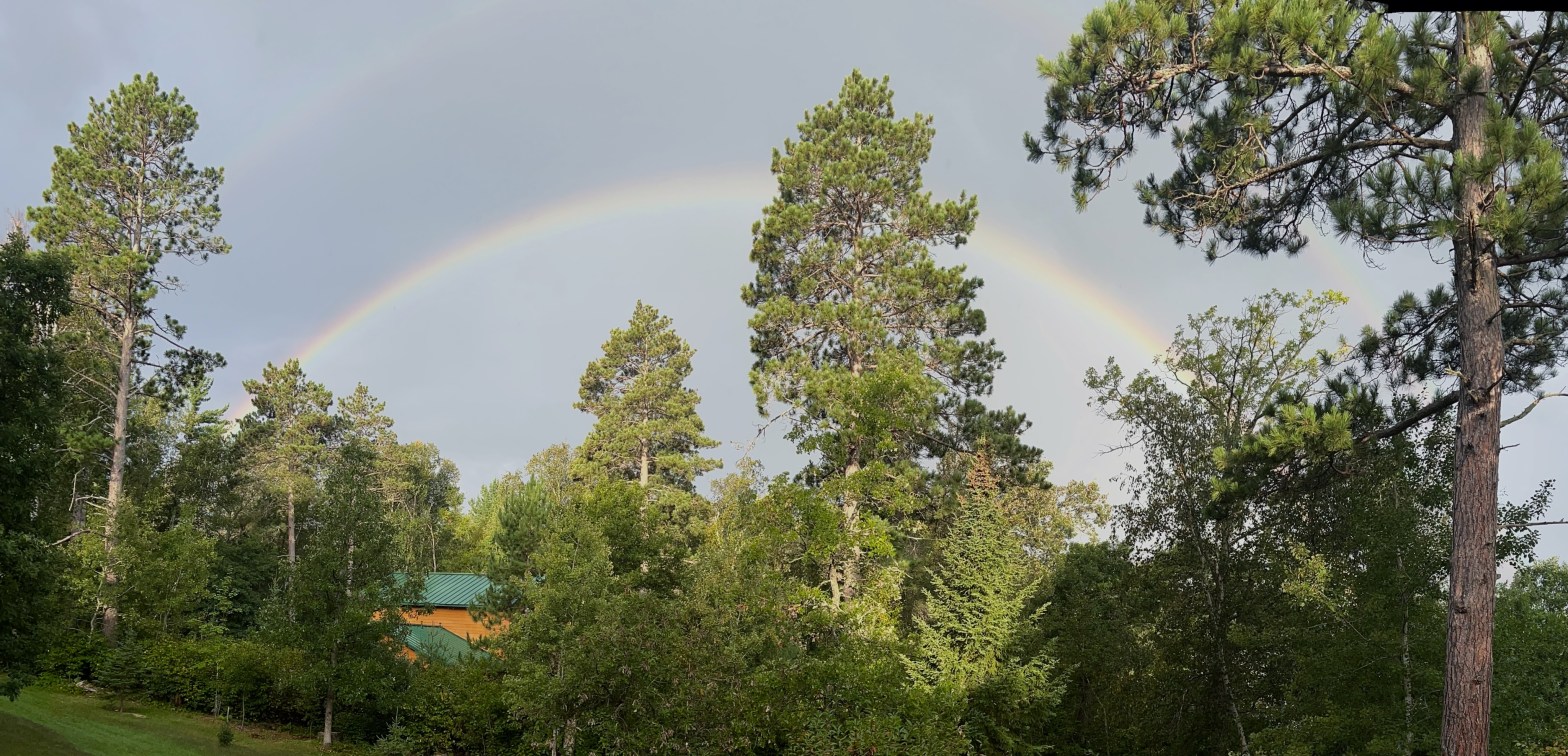

These pictures were taken looking west across our lake around 8AM on September 6, 2024. There was a slight rain shower to the west with sunlight from the east hitting the raindrops. Sunlight is reflected back towards the observer by the raindrops.
Because of the refractive index of water, the wavelength of light, and the spherical shape of the drops, sunlight that hits the top surface of raindrops at an angle of 42 degrees is reflected back most intensely.
The rainbow is reflected light from the cone of raindrops that sunlight hits at angle of about 42 degrees. The exact angle of maximum reflectance is influenced by the wavelength of the incident light. The slightly different wavelengths corresponding to different colors of light are what cause the reflected light of the rainbow to appear with separated colors.


A smaller amount of sunlight hitting raindrops is reflected twice within the drops. This light reaches maximum intensity at 51 degrees and produces a secondary rainbow, fainter and with a wider diameter than the primary rainbow.
Violet, with the shortest wavelength, is along the inside arc of a primary rainbow and red, with the longest wavelength is on the outside arc. The geometry of double reflection causes the order of these colors to be reversed in the secondary rainbow, as can be seen in the picture above.
Explaining the physics behind rainbows has been a focus of many of the most famous philosophers/scientists in history, from Aristotle to Descartes to Newton.
 North MN Outdoors